Northeast Florida Real Estate News & Market Trends

You’ll find our blog to be a wealth of information, covering everything from local market statistics and home values to community happenings. That’s because we care about the community and want to help you find your place in it. Please reach out if you have any questions at all. We’d love to talk with you!

Aug. 8, 2022

Expert Housing Market Forecasts for The Second half of The Year

Expert Housing Market Forecasts for the Second Half of the Year

Expert Housing Market Forecasts for the Second Half of the Year | MyKCM

The housing market is at a turning point, and if you’re thinking of buying or selling a home, that may leave you wondering: is it still a good time to buy a home? Should I make a move this year? To help answer those questions, let’s turn to the experts for projections on what the second half of the year holds for residential real estate.

Where Mortgage Rates Will Go Depends on Inflation

While one of the big questions on all buyers’ minds is where will mortgage rates go in the months ahead, no one has a crystal ball to know exactly what’ll happen in the future. What housing market experts know for sure is that the record-low mortgage rates during the pandemic were an outlier, not the norm.

This year, rates have climbed over 2% due to the Federal Reserve’s response to rising inflation. If inflation continues to rise, it’s likely that mortgage rates will respond. Greg McBride, Chief Financial Analyst at Bankrateexplains it well:

“Until inflation peaks, mortgage rates won’t either. Without improvement on the inflation front, we don’t know where the interest rate ceiling will be.”

Whether you’re buying your first home or selling your current house to make a move, today’s mortgage rate is an important factor to consider. When rates rise, they impact affordability and your purchasing power. That’s why it’s crucial to work with a team of professionals, so you have expert advice to help you make an informed decision about your best move.

The Supply of Homes for Sale Projected To Continue Increasing

This year, particularly this spring, the number of homes for sale has grown. That’s partly due to more homeowners listing their houses, but also because higher mortgage rates have helped ease the intensity of buyer demand. Moderating buyer demand slows down the pace of home sales, which in turn helps inventory rise.

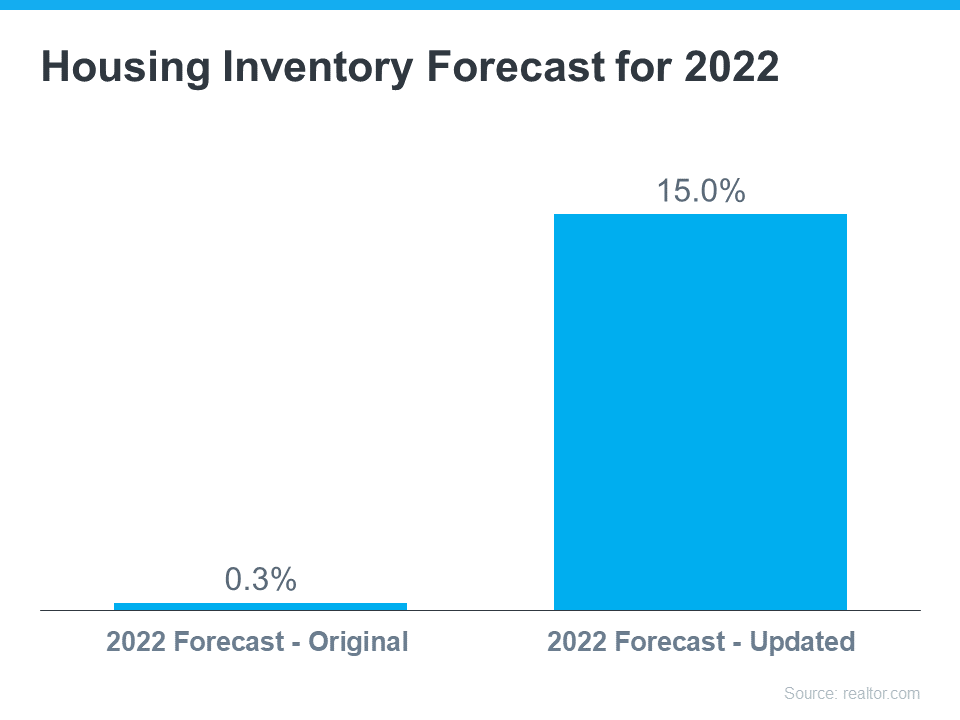
Experts say that growth will continue. Recently, realtor.com updated their 2022 inventory forecast. In the latest release, they increased their projections for inventory gains dramatically, going from a 0.3% increase at the beginning of the year to a 15.0% jump by the end of 2022 (see graph below):
Expert Housing Market Forecasts for the Second Half of the Year | MyKCM

More homes to choose from is great news if you’re craving more options for your home search – just know that there isn’t a sudden surplus of inventory on the horizon. Housing supply is still low, so you’ll need to partner with an agent to stay on top of what’s available in your market and move fast when you find the one. It’s not going to be easy to find a home, but it certainly won’t be as difficult as it has been over the past two years.

Home Price Forecasts Call for Ongoing Appreciation

Due to the imbalance between the number of homes for sale and the number of buyers looking to make a purchase, the pandemic led to record-breaking increases in home prices. According to CoreLogic, homes appreciated by 15% in 2021, and they’ve continued to rise this year.

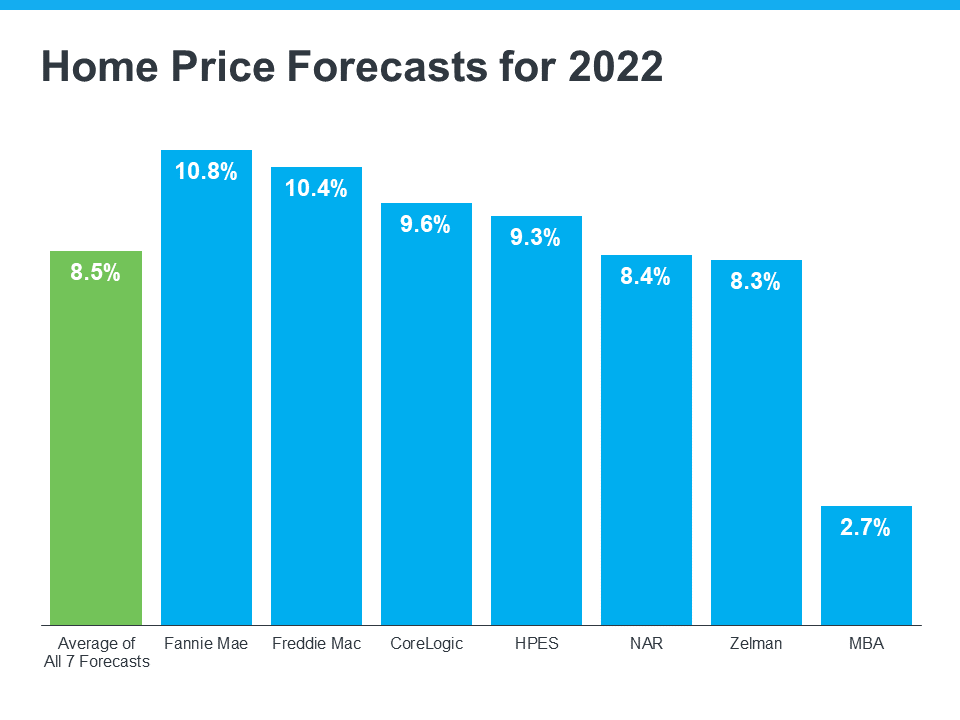
Even though housing supply is increasing today, there are still more buyers than there are homes for sale, and that’s maintaining the upward pressure on home prices. That’s why experts are not calling for prices to decline, rather they’re forecasting they’ll continue to climb, just at a more moderate pace this year. On average, homes are projected to appreciate by about 8.5% in 2022 (see graph below):
Expert Housing Market Forecasts for the Second Half of the Year | MyKCM

Selma Hepp, Deputy Chief Economist at CoreLogic, explains why the housing market will see deceleration, but not depreciation, in prices:

“The current home price growth rate is unsustainable, and higher mortgage rates coupled with more inventory will lead to slower home price growth but unlikely declines in home prices.

For current homeowners looking to sell, know your home’s value isn’t projected to fall, but waiting to make your purchase does mean your next home could cost more as home prices continue to appreciate. That’s why, if you’re thinking about buying your first home or you’re ready to make a move, it may make sense to do so now before prices climb higher. But rest assured, once you buy a home, that price appreciation will help grow the value of your investment.

Bottom Line

Whether you’re a homebuyer or seller, you need to know what’s happening in the housing market, so you can make the most informed decision possible. Let’s connect to discuss your goals and what lies ahead, so you can determine the best plan for your move.

Aug. 3, 2022

Three Reasons To Buy a Home in Today’s Shifting Market

Three Reasons To Buy a Home in Today’s Shifting Market [INFOGRAPHIC] | MyKCM

Some Highlights

  • The housing market is moving away from the frenzy of the past year and it’s opening doors for you if you’re thinking about buying a home.
  • Housing inventory is increasing, which means more options for your search. Plus, the intensity of bidding wars may ease as buyer demand moderates, leading to fewer homes selling above asking price.
  • If you’re ready to buy a home, now may be the moment you’ve been waiting for. Let’s connect to start the homebuying process today.
Aug. 2, 2022

Higher Rates & Short Supply: The State of Real Estate 2022

Higher Rates and Short Supply: The State of Real Estate in 2022

Higher Rates and Short Supply: The State of Real Estate in 2022


The last two years caught many of us off guard—and not just because of the pandemic. They also ushered in the hottest housing market on record, with home prices rising nationally by nearly 19% in 2021, driven primarily by low mortgage rates and a major supply shortage.1


But while some had hoped 2022 would bring a return to normalcy, the U.S. real estate market continues to boom, despite rising interest rates and decreasing affordability.


So what’s driving this persistent demand? And is there an end in sight?

Here are three factors impacting the real estate market right now. Find out how they could affect you if you’re a current homeowner or plan to buy or sell a home this year.


MORTGAGE RATES ARE RISING FASTER THAN EXPECTED

Over the past couple of years, homebuyers have faced intense competition for new homes—in part due to historically low mortgage rates that were a result of the Federal Reserve’s efforts to keep the economy afloat during the COVID-19 pandemic.


However, in response to a concerning level of inflation, the Fed is now reversing those efforts by raising the federal funds rate. And as a result, mortgage rates are rising, as well. Few experts predicted, though, that mortgage rates would go up as quickly as they have.


In January 2022, the Mortgage Bankers Association projected that rates would reach 4% by the end of this year.2 By mid-April, however, the average 30-year fixed mortgage rate had already hit 5%, up from around 3% just one year prior.3 On a $400,000 mortgage, that 2% difference could translate into an additional $461 per monthly payment.


Since then, mortgage rates have continued on an upward trend. So what impact are these rising rates having on demand? While many buyers had hoped for a cooling effect, experts warn that may not be the case.


Ali Wolf, chief economist at housing market research firm Zanda, told Fortune magazine, "Rising mortgage rates are having a counterintuitive effect on the housing market. Home shoppers are actually sprung into action in an attempt to buy a home before mortgage rates rise any higher."4


Since inventory remains low, the resulting “race” has kept the homebuying market highly competitive–at least for now.


What does it mean for you?

While current 30-year fixed mortgage rates represent an increase over previous months, they remain well below the historical average of 8%.5 As inflation across the economy continues, the Fed is likely to raise rates further this year. Buyers should act fast to secure a good mortgage rate. We’d be happy to refer you to a lender who can help.


For sellers, speed is also of the essence. The pool of potential buyers may shrink as mortgages become more expensive. And if you plan to finance your next home, you’ll want to act quickly to secure a favorable rate for yourself. Contact us today to discuss your options.


HOME PRICES KEEP CLIMBING

History shows that higher interest rates don’t necessarily translate to lower home prices. In fact, home prices rose 5% between 1980 and 1982, a period of significantly higher mortgage rates and inflation.5


Forecasters expect that home prices will continue to go up throughout 2022, though likely at a slower pace than the 18.8% increase of the last 12 months.4 Bank of America predicts that prices will be up approximately 10% by the end of this year, while Fannie Mae estimates 11.2%.6,7


In addition to limited supply and a race to beat rising mortgage rates, home values are also climbing because of positive economic indicators, like low unemployment.8 Plus, rents are soaring–up 17% from a year ago–which is prompting more first-time homebuyers to enter the market.9 Add to that the continued popularity of remote work, and it’s easy to see why property prices continue to surge.


However, it’s not all bad news for prospective homebuyers. Economists expect that as mortgage rates rise, the rate of appreciation will continue to taper, though the effect may be gradual.


“Eventually mortgage rates will slow down home prices,” according to Ken Johnson, an economist at Florida Atlantic University interviewed by Marketwatch.10 “We should not see rapid upticks in prices as mortgage rates rise.” Forecasters agree—Fannie Mae expects price increases to slow to 4.2% in 2023.7


What does it mean for you?

While the pace of appreciation is likely to decrease next year, home prices show no signs of going down. However, current labor shortages are leading to higher salaries and better job opportunities for many workers. You may find that your income growth outpaces home prices, making homeownership more affordable for you in the future.


For homeowners, the outlook’s even brighter. You could find yourself sitting on a nice pile of equity. Contact us for a free home value assessment to find out.


INVENTORY REMAINS EXTREMELY LOW

As noted, one of the largest hurdles to homeownership is a lack of inventory. According to a February 2022 report by Realtor.com, there’s an expanding gap between household formation and home construction, which has resulted in a nationwide shortage of 5.8 million housing units.11


The origins of this shortage date back to the 2008 housing crisis, during which crashing home values led contractors to stop building new properties—a trend that has not been fully reversed.12


That decline in home construction also resulted in a decrease in the number of home building professionals, a trend that was exacerbated by job losses during the COVID-19 pandemic. Now, many builders are limited by their ability to find qualified labor.


Another major challenge is a staggering increase in the cost of materials. Pandemic-related supply chain shortages have been a significant driver, with home building material costs rising on average 20% on a year-over-year basis. The price of framing lumber alone has tripled since August 2021.13


These trends add tens of thousands of dollars to the cost of a typical home. Factors like a lack of buildable land in many areas, restrictive zoning, and a shortage of developers are also contributing to the issue.14


Most homebuying experts agree that the lack of inventory is the primary factor driving rising housing prices and unprecedented competition for homes. With available housing units near four-decade lows, the end of the current housing boom is not yet in sight.15


What does it mean for you?

Prospective buyers should be prepared to compete for a home, since low inventory can lead to multiple offers. You may also need to expand your search parameters. If you’re ready to look, we’re ready to help.


For sellers, the picture is rosier. In this strong market, your home may be worth more than you realize. Contact us to find out how much your home could sell for in today’s market.


WE’RE HERE TO GUIDE YOU

While national real estate trends can provide a “big picture” outlook, real estate is local. And as local market experts, we can guide you through the ins and outs of our market and the local issues that are likely to drive home values in your particular neighborhood.


If you’re considering buying or selling a home, contact us now to schedule a free consultation. We can help you assess your options and make the most of this unique real estate landscape.


Aug. 1, 2022

Should I Rent or Should I Buy?

Should I Rent or Should I Buy? [INFOGRAPHIC]

Should I Rent or Should I Buy? [INFOGRAPHIC] | MyKCM

Some Highlights

  • It’s worth considering the many benefits of homeownership before you make the decision to rent or buy a home.
  • When you buy, you can stabilize your housing costs, own a tangible asset, and grow your net worth as you gain equity. When you rent, you face rising housing costs, won’t see a return on your investment, and limit your ability to save.
  • If you want to learn more about the benefits of homeownership, let’s connect today.
Posted in Market Updates
July 19, 2022

Why Pre-Approval is a Game Changer for Homebuyers

Why Pre-Approval Is a Game changer for Homebuyers

Why Pre-Approval Is a Game Changer for Homebuyers | MyKCM

If you’re planning to buy a home this year, you might have heard that pre-approval is a necessary step to take before starting out on your journey. But why is that? And is it still important in today’s shifting market?

The truth is, getting a pre-approval letter from your lender is critical, and when it comes to your home search, it can be a game changer in so many ways.

To better understand why, it’s important to know what pre-approval is. Freddie Mac defines the process like this:

“A pre-approval is an indication from your lender that they are willing to lend you a certain amount of money to buy your future home. The lender you work with will provide you with a pre-approval letter, which is an official document that states the maximum amount they are willing to lend you, . . .”

Put simply, pre-approval from a lender helps you understand your true price range and how much money you can borrow for your loan. That can make it easier when you set out to search for homes. And since you’ll know what you’re approved for, it’ll also help once it’s time to submit an offer on the home of your dreams.

Another added benefit is that pre-approval lets the seller know you’re qualified to buy their house. Paul Centopani, Editor for the Mortgage Reportsexplains:

“. . . most sellers won’t even consider an offer unless the buyer is pre-approved at the right price point. Sellers and their agents want to know you’re ready and able to finance your offer amount. So you’ll want to have your preapproval teed up as soon as you’re serious about bidding on a home you like.”

Every advantage you can gain as a buyer is crucial in a market that’s constantly changing. You’re going to need guidance to navigate these waters, so it’s important to have a team of professionals, such as a real estate advisor and trusted lender, on your side. They’ll help make sure you’re ready to put your best foot forward.

Bottom Line

Getting pre-approved for a mortgage helps you better understand what you can borrow and shows sellers you’re serious about purchasing their home. Let’s connect so you have the tools you need to succeed as a homebuyer in today’s shifting market.

June 27, 2022

What You Actually Need To Know About the Number of Foreclosures in Today’s Housing Market

What You Actually Need To Know About the Number of Foreclosures in Today’s Housing Market

What You Actually Need To Know About the Number of Foreclosures in Today’s Housing Market | MyKCM

While you may have seen recent stories about the volume of foreclosures today, context is important. During the pandemic, many homeowners were able to pause their mortgage payments using the forbearance program. The goal was to help homeowners financially during the uncertainty created by the health crisis.

When the forbearance program began, many experts were concerned it would result in a wave of foreclosures coming to the market, as there was after the housing crash in 2008. Here’s a look at why the number of foreclosures we’re seeing today is nothing like the last time.

1. There Are Fewer Homeowners in Trouble

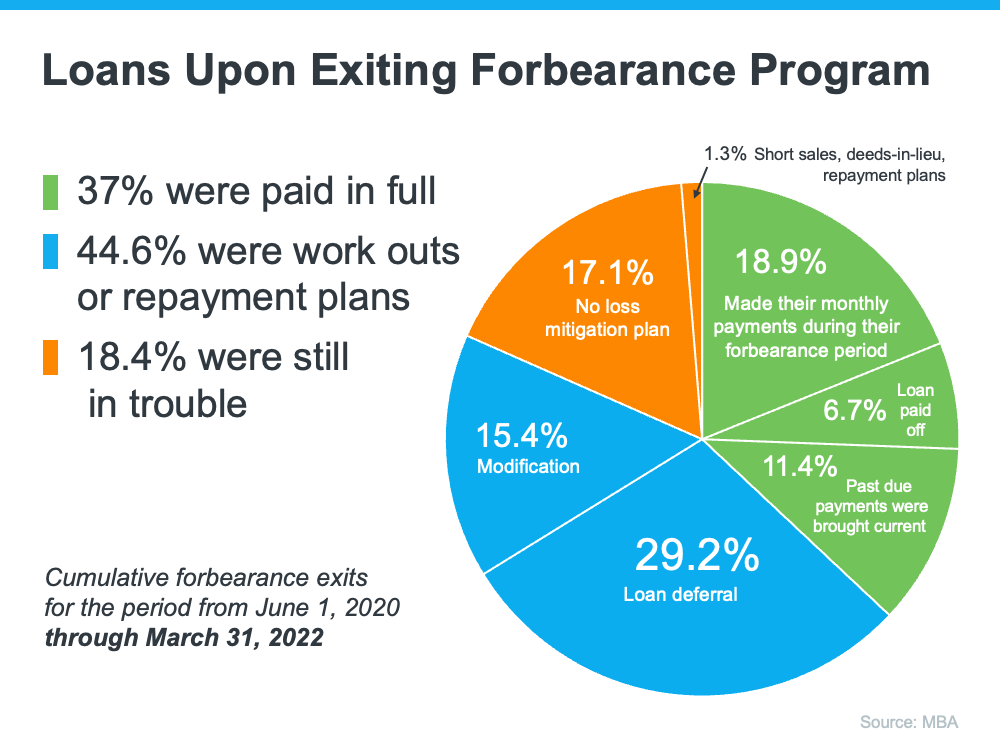
Today’s data shows that most homeowners are exiting their forbearance plan either fully caught up on payments or with a plan from the bank that restructured their loan in a way that allowed them to start making payments again. The graph below depicts those findings from the Mortgage Bankers Association (MBA):

What You Actually Need To Know About the Number of Foreclosures in Today’s Housing Market | MyKCM

The same MBA report mentioned above estimates there are approximately 525,000 homeowners who remain in forbearance today. Thankfully, those people still have the chance to work out a suitable repayment plan with the servicing company that represents their lender.

2. Most Homeowners Have Enough Equity To Sell Their Homes

For those who are exiting the forbearance program without a plan in place, many will have enough equity to sell their homes instead of facing foreclosures. Due to rapidly rising home prices over the last two years, the average homeowner has gained record amounts of equity in their home.

Marina Walsh, CMB, Vice President of Industry Analysis at MBA, says:

“Given the nation’s limited housing inventory and the variety of home retention and foreclosure alternatives on the table across various loan types, . . . Borrowers have more choices today to either stay in their homes or sell without resorting to a foreclosure.”

3. There Have Been Fewer Foreclosures over the Last Two Years

One of the seldom-reported benefits of the forbearance program was it gave homeowners facing difficulties an extra two years to get their finances in order and work out a plan with their lender. That helped prevent the foreclosures that normally would have come to the market had the new forbearance program not been available.

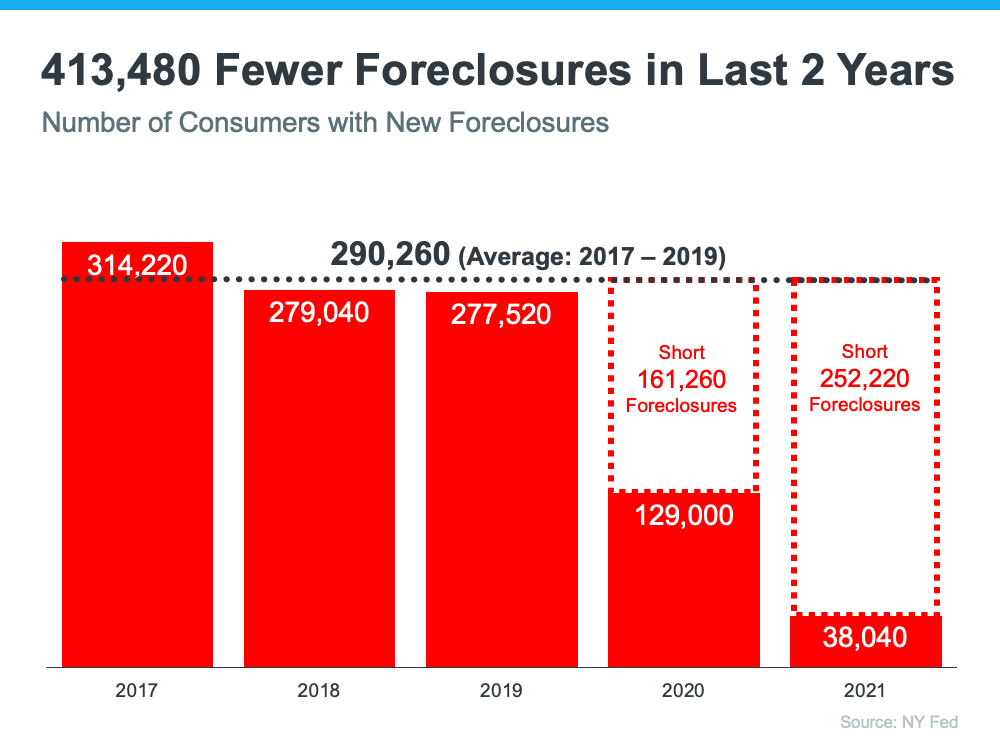
Even as people leave the forbearance program, there are still fewer foreclosures happening today than before the pandemic. That means, while there are more foreclosures now compared to last year (when foreclosures were paused), the number is still well below what the housing market has seen in a more typical year, like 2017-2019 (see graph below):

What You Actually Need To Know About the Number of Foreclosures in Today’s Housing Market | MyKCM

4. The Current Market Can Easily Absorb New Listings

When the foreclosures in 2008 hit the market, they added to the oversupply of houses that were already for sale. It’s exactly the opposite today. The latest Existing Home Sales Report from the National Association of Realtors (NAR) reveals:

“Total housing inventory at the end of March totaled 950,000 units, up 11.8% from February and down 9.5% from one year ago (1.05 million). Unsold inventory sits at a 2.0-month supply at the present sales pace, up from 1.7 months in February and down from 2.1 months in March 2021.”

A balanced market would have approximately a six-month supply of inventory. At 2.0 months, today’s housing market is severely understocked. Even if one million homes enter the market, there still won’t be enough inventory to meet the current demand.

Bottom Line

If you see headlines about the increasing number of foreclosures today, remember context is important. While it’s true the number of foreclosures is higher now than it was last year, foreclosures are still well below pre-pandemic years.

If you have questions, let’s connect to talk through the latest market conditions and what they mean for you.

June 20, 2022

Three Tips for First-Time Homebuyers

Three Tips for First-Time Homebuyers

Three Tips for First-Time Homebuyers | MyKCM

Buying your first home is a major decision and an exciting milestone. Even though it can feel daunting at times, it has the power to change your life for the better. If you're looking to purchase your first home, you may be wondering what's happening in the housing market today, how much you need to save, and where to start.

Here are three things that can help give you the information you need to confidently pursue your dream of homeownership.

1. Consider All Options When the Number of Homes for Sale Is Low

Today, there are far more buyers in the market than there are homes available for sale. When that happens, it’s a good idea to do what you can to increase your pool of options. That could mean expanding your search to include additional housing types. For first-time buyers, considering condominiums (condos) and townhomes can be an excellent way to increase your choices. According to Bankrate:

“Townhomes often cost less than single-family homes of a similar size in the same location.”

In another article, Bankrate also says:

“Buying a condo can be a great way to dive into homeownership without worrying about the upkeep that comes with single-family homes and townhouses.”

Condos and townhomes are both great entryways into homeownership. When you buy either one, you can start building equity which increases your net worth and can fuel a future move.

2. Know Your Down Payment Could Be More Within Reach Than You Think

Saving for a down payment can feel like one of the biggest obstacles for homebuyers, but that doesn’t have to be the case. As the National Association of Realtors (NAR) says:

One of the biggest misconceptions among housing consumers is what the typical down payment is and what amount is needed to enter homeownership.”

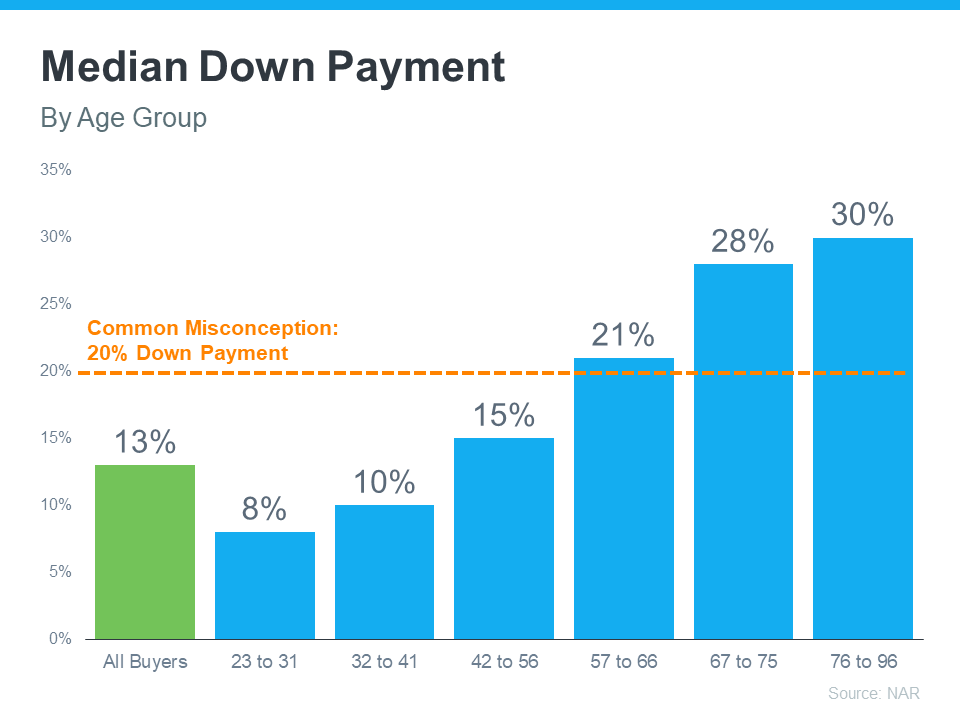
Data from NAR shows the median down payment hasn’t been over 20% since 2005. The graph below breaks down the median down payment by age group for recent homebuyers according to the 2022 Home Buyers and Sellers Generational Trends Report from NAR (see graph below):

Three Tips for First-Time Homebuyers | MyKCM

Based on the data above, the median down payment for all homebuyers is only 13%. That’s well below the common misconception of 20%, and it’s even lower for younger buyers. This could mean you may not need to save as much for a down payment as you initially thought.

There are also down payment assistance programs available for many buyers. Not to mention, some loan options require as little as 3.5% (or even 0%) down for buyers who qualify. While there are advantages to putting 20% down, especially in today’s competitive market, know that you have options.  To get more information on how much you may need to save and the help that’s available, talk with a professional.

3. Work with a Trusted Real Estate Advisor Throughout the Process

Finally, no matter where you’re at in your homeownership journey, the best way to make sure you’re set up for success is to work with a real estate professional.

If you’re just starting out, they can help you with the initial steps, like educating you on the process and connecting you with a trusted lender to get pre-approved. Once you’re ready to begin your search, a real estate professional can help you understand your local market and search for available homes. And when it’s time to make an offer, they’ll be an expert advisor and negotiator to help your offer stand out above the rest.

Bottom Line

Knowledge is key to succeeding on your homebuying journey. Knowing market trends, what you need for a down payment, and what options you have as a buyer today can give you the confidence you need to buy a home. Let’s connect so you have an expert on your side who can help you navigate the homebuying process.

June 13, 2022

Don’t Let Rising Inflation Delay Your Homeownership Plans

Don’t Let Rising Inflation Delay Your Homeownership Plans 

Don’t Let Rising Inflation Delay Your Homeownership Plans INFOGRAPHIC] | MyKCM

Some Highlights

  • If recent headlines about rising inflation are making you wonder if it’s still a good time to buy, here’s what experts have to say.
  • Housing is an asset that typically grows in value. Plus, your mortgage helps stabilize your monthly housing costs, and buying protects you from rising rents.
  • Experts say owning a home is historically a good hedge against inflation. Let’s connect if you’re ready to start the homebuying process today.
May 21, 2021

4 Major Reasons Households in Forbearance Won’t Lose Their Homes to Foreclosure

Waiting to cash in on a market crash and foreclosures? Think again. - May 21, 2021

 Shannon Macourek

4 Major Reasons Households in Forbearance Won’t Lose Their Homes to Foreclosure | MyKCM

There has been a lot of discussion as to what will happen once the 2.3 million households currently in forbearance no longer have the protection of the program. Some assume there could potentially be millions of foreclosures ready to hit the market. However, there are four reasons that won’t happen.

1. Almost 50% Leave Forbearance Already Caught Up on Payments

According to the Mortgage Bankers Association (MBA), data through March 28 show that 48.9% of homeowners who have already left the program were current on their mortgage payments when they exited.

  • 26.6% made their monthly payments during their forbearance period
  • 14.7% brought past due payments current
  • 7.6% paid off their loan in full

This doesn’t mean that the over two million still in the plan will exit exactly the same way. It does, however, give us some insight into the possibilities.

2. The Banks Don’t Want the Houses Back

Banks have learned lessons from the crash of 2008. Lending institutions don’t want the headaches of managing foreclosed properties. This time, they’re working with homeowners to help them stay in their homes.

As an example, about 50% of all mortgages are backed by the Federal Housing Finance Agency (FHFA). In 2008, the FHFA offered 208,000 homeowners some form of Home Retention Action, which are options offered to a borrower who has the financial ability to enter a workout option and wants to stay in their home. Home retention options include temporary forbearances, repayment plans, loan modifications, or partial loan deferrals. These helped delinquent borrowers stay in their homes. Over the past year, the FHFA has offered that same protection to over one million homeowners.

Today, almost all lending institutions are working with their borrowers. The report from the MBA reveals that of those homeowners who have left forbearance,

  • 35.5% have worked out a repayment plan with their lender
  • 26.5% were granted a loan deferral where a borrower does not have to pay the lender interest or principal on a loan for an agreed-to period of time
  • 9% were given a loan modification

3. There Is No Political Will to Foreclose on These Households

The government also seems determined not to let individuals or families lose their homes. Bloomberg recently reported:

“Mortgage companies could face penalties if they don’t take steps to prevent a deluge of foreclosures that threatens to hit the housing market later this year, a U.S. regulator said. The Consumer Financial Protection Bureau (CFPB) warning is tied to forbearance relief that’s allowed millions of borrowers to delay their mortgage payments due to the pandemic…mortgage servicers should start reaching out to affected homeowners now to advise them on ways they can modify their loans.”

The CFPB is proposing a new set of guidelines to ensure people will be able to retain their homes. Here are the major points in the proposal:

  • The proposed rule would provide a special pre-foreclosure review period that would generally prohibit servicers from starting foreclosure until after December 31, 2021.
  • The proposed rule would permit servicers to offer certain streamlined loan modification options to borrowers with COVID-19-related hardships based on the evaluation of an incomplete application.
  • The proposal rule wants temporary changes to certain required servicer communications to make sure borrowers receive key information about their options at the appropriate time.

A final decision is yet to be made, and some do question whether the CFPB has the power to delay foreclosures. The entire report can be found hereProtections for Borrowers Affected by the COVID-19 Emergency Under the Real Estate Settlement Procedures Act (RESPA), Regulation X.

4. If All Else Fails, Homeowners Will Sell Their Homes Before a Foreclosure

Homeowners have record levels of equity today. According to the latest CoreLogic Home Equity Report, the average equity of mortgaged homes is currently $204,000. In addition, 38% of homes do not have a mortgage, so the level of equity available to today’s homeowners is significant.

Just like the banks, homeowners learned a lesson from the housing crash too.

“In the same way that grandparents and great grandparents were shaped by the Great Depression, much of the public today remembers the 2006 mortgage meltdown and the foreclosures, unemployment, and bank failures it created. No one with any sense wants to repeat that experience...and it may explain why so much real estate equity remains mortgage-free.”

What does that mean to the forbearance situation? According to Black Knight:

“Just one in ten homeowners in forbearance has less than 10% equity in their home, typically the minimum necessary to be able to sell through traditional real estate channels to avoid foreclosure.”

Bottom Line

The reports of massive foreclosures about to come to the market are highly exaggerated. As Ivy Zelman, Chief Executive Officer of Zelman & Associates with roughly 30 years of experience covering housing and housing-related industries, recently proclaimed:

“The likelihood of us having a foreclosure crisis again is about zero percent.”


May 18, 2021

Is Home Price Appreciation Accelerating Again?

At the beginning of 2021, real estate experts forecasted more inventory to level out the market, but that's not the case in the NE Florida area - May 18, 2021 at 9:00AM

 Shannon Macourek

Is Home Price Appreciation Accelerating Again? | MyKCM

At the beginning of the year, industry forecasts called for home price appreciation to slow to about half of the double-digit increase we saw last year. The thinking was that inventory would increase from record-low levels and put an end to the bidding wars that have driven home prices up over the past twelve months. However, that increase in inventory has yet to materialize. The National Association of Realtors (NAR) reports that there are currently 410,000 fewer single-family homes available for sale than there were at this time last year.

This has forced those who made appreciation forecasts this past January to amend those projections. The Mortgage Bankers AssociationFannie MaeFreddie Mac, the National Association of Realtors, and Zelman & Associates have all adjusted their numbers upward after reviewing first quarter housing data. Here are their original forecasts and their newly updated projections:Is Home Price Appreciation Accelerating Again? | MyKCMEven with the increases, the updated projections still don’t reach the above 10% appreciation levels of 2020. However, a jump in the average projection from 5.3% to 7.7% after just one quarter is substantial. Demand will remain strong, so future appreciation will be determined by how quickly listing inventory makes its way to the market.

Bottom Line

Entering 2021, there was some speculation that we might see price appreciation slow dramatically this year. Today, experts believe that won’t be the case. Home values will remain strong throughout the year.